
Handheld radios still earn their keep when phone service fades, hands get busy, or a group needs a simple way to stay in step. The right pick depends on where you use it most, whether that means a jobsite, a marina, a campsite, or a backup kit at home. This roundup keeps the focus on practical fit, with a clear look at durability, power, range claims, and the trade-offs that matter once the device is in your hand.
Some of these choices lean rugged, some lean compact, and a few lean hard into emergency readiness. That mix helps you match the radio to the situation instead of forcing one style into every role.
The Shortlist At A Glance

Solar Radio Emergency Hand Crank 12000mAh

SAMCOM FPCN30A Two Way Radios Long Range 5 Watts

Retevis RB48 IP67 Waterproof Walkie Talkies Long Range
Standard Horizon HX210 6W Floating Handheld Marine VHF

Motorola Solutions T605_H2O Talkabout Waterproof Walkie Talkies
Baofeng Walkie Talkies 888S Rechargeable Long Range
Baofeng Radio UV-5R Mini Ham Radio Long Range Handheld
BAOFENG DM32 DM-32UV DMR Digital Two-Way Radio
More Details On Our Top Picks
Power backup is the point here, and that makes this Mesqool a strong fit for storm kits, road trips, and homes that want a radio that still has a pulse after the power goes out. The 12,000mAh battery capacity, if charged ahead of time, gives you a much wider buffer than a plain battery-only set, while the hand crank and solar support add extra ways to keep it going.
The trade-off is size and setup attention, because a feature-dense emergency radio usually asks for a little more planning than a basic walkie-talkie. You also get dual outputs for charging other devices and a two-mode LED flashlight, so it suits you best when one device has to cover several backup jobs at once.
Strong Points
- Hand crank, solar, and battery support give you more charging paths than a standard handheld set.
- 12,000mAh capacity makes sense for emergency shelves, long outages, or a packed travel bag.
- Dual outputs let the radio pull double duty in a pinch.
- The built-in flashlight adds useful overnight visibility without needing a separate torch.
Small Caveats
- It asks for a little more prep, since emergency gear works best when you keep it charged and ready.
- The multi-role design adds bulk compared with simpler handheld radios.
Feature Snapshot
Who Should Grab It
You get the most from this one in a household emergency kit, a vehicle stash, or a cabin where backup power matters more than compact size.
Where A Sibling Pick Shines
Motorola Solutions T605_H2O Talkabout Waterproof Walkie Talkies make more sense for casual outdoor use, since they are less specialized and easier to hand around on a family outing.
Busy crews need clear, repeatable communication, and this SAMCOM leans into that with a 5-watt output and UHF design. UHF means ultra-high frequency, which is commonly favored in built-up spaces because it tends to handle walls and close-quarters work better than a looser, open-field setup.
It comes as a 6-pack with earpieces, so it fits teams that want everyone on the same channel without hunting for add-ons. The honest read is that this is more radio than casual family use usually needs, but for construction, event staff, or warehouse coordination, that extra structure is the whole point.
What We Like
- 5-watt output gives the set a more serious work profile than lighter-duty handhelds.
- The 6-pack format suits group coordination straight away.
- Included earpieces help keep conversations private in noisy spaces.
- UHF support is a smart fit for indoor or semi-indoor work zones.
- Rechargeable design cuts down on routine battery swapping.
Points To Note
- The larger pack size makes storage and charging logistics more important.
- Earpieces add convenience, but they also mean more pieces to keep track of.
- Its work-first design can feel like overkill for simple backyard use.
Core Details
Made For
You get the best fit here for site supervisors, event teams, and operations crews that need multiple handheld radios in one go.
Another Choice May Suit
Baofeng Walkie Talkies 888S Rechargeable Long Range make more sense for smaller groups that want a bigger pack count without the same emphasis on workplace structure.
Construction crews and outdoor workers will notice the Retevis RB48 design language right away, because it’s built around protection rather than polish. IP67 means it’s sealed against dust and can handle temporary water exposure, while MIL-STD-810H points to a tougher build profile used for environmental stress resistance.
The front PTT button, or push-to-talk button, is large enough to be useful with gloves, and the vibration alert adds a quiet signal option for louder sites. Compared with the SAMCOM pack, this one feels more abuse-ready, and the floating design gives you a real comfort factor near water.
Highlights
- IP67 sealing is a strong match for wet, dusty, or messy work zones.
- MIL-STD-810H build language points to a tougher field-ready design.
- The large front PTT button works well with gloves.
- Floating behavior is useful near docks, boats, or water-focused jobs.
- Vibration alert gives you a discreet cue in loud settings.
Areas To Watch
- The rugged shell is practical, but it also makes the radio feel more work-first than casual.
- Water-resistant gear still needs regular drying and cleaning after rough use.
- The feature set suits demanding sites, which can be more than you need for simple family trips.
At A Glance
Built With In Mind
You get the strongest fit here for contractors, dock crews, and outdoor teams that need a tougher handheld radio with weather resistance.
Swap It Out When
Standard Horizon HX210 6W Floating Handheld Marine VHF suits boat owners more naturally, since it is tuned for marine communication rather than general jobsite use.
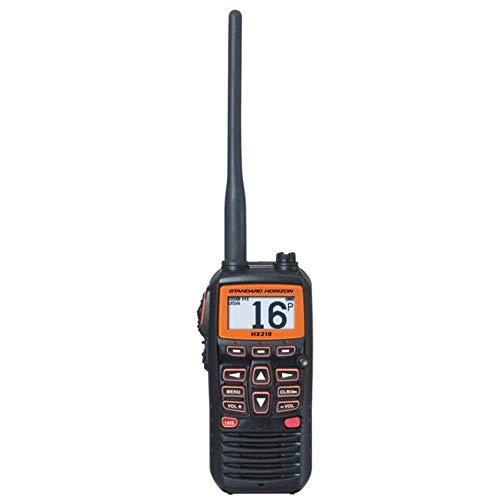
Water is the whole story here, and that’s why the HX210 stands apart from the jobsite radios above it. A floating handheld marine VHF transceiver is built for boat communication, dock use, and other marine settings where a dropped radio should not become a lost one.
The included antenna, rapid charger cradle, and documentation make the box feel complete right away, and the three-year waterproof warranty is a notable extra for this category. One thing worth considering is that marine radios live best on boats or around the harbor, not in the broader mixed-use role that the Motorola or BAOFENG picks can cover.
Best Bits
- Floating design helps in dockside and boating settings.
- 6W output gives the unit a stronger communication profile for marine use.
- The box includes the antenna and rapid charger cradle.
- Three-year waterproof warranty adds reassuring ownership value.
- Purpose-built marine hardware tends to feel more natural on the water than a general radio.
Trade Offs
- The marine focus makes it less versatile for everyday land use.
- It’s a better fit for boat decks and marinas than for mixed household duty.
Details At A Glance
Whose Shelf It Belongs On
You get the most value here as a boat owner, marina worker, or coastal traveler who wants a marine VHF radio rather than a general-purpose walkie-talkie.
Look Elsewhere When
Retevis RB48 IP67 Waterproof Walkie Talkies Long Range suits jobsite users better, since its rugged, glove-friendly layout leans harder into construction work.
This Motorola set lands in a sweet spot for casual outdoor use, especially for families that want a familiar format without a lot of setup friction. The FRS label means Family Radio Service, a short-range two-way radio standard that’s usually simple to use and friendly for group outings, neighborhood tasks, or emergency bins.
Its orange-and-black shell is easy to spot, which helps in a crowded camp site or a packed garage, and the waterproof focus keeps it from feeling too delicate. Compared with the more specialized Standard Horizon and Retevis picks, this one is a calmer everyday carry choice, though the exact range you get will still depend heavily on terrain and obstacles.
Positives
- FRS simplicity keeps the learning curve low for group use.
- Waterproof construction makes it more comfortable around rain, spray, or wet gear.
- The bright color scheme is easy to spot during a busy outing.
- Rechargeable power helps reduce routine battery swaps.
- Two-pack format works well for a parent-child pair or a couple of adults on the move.
Room For Improvement
- Terrain can affect real-world range more than the product page language suggests.
- The simple layout is friendly, but it leaves less room for advanced control.
Core Details
The Right Fit
You get the best match here for families, casual hikers, and weekend campers who want a straightforward waterproof handheld radio.
Reach For A Different Pick When
SAMCOM FPCN30A Two Way Radios Long Range 5 Watts suits work crews better, since its 6-pack format and UHF focus are more aligned with team communication.
The 10-pack shape tells you exactly where this Baofeng belongs, because it’s aimed at larger groups that need a stack of radios rather than a single personal unit. Sixteen channels give you some room to sort conversations, and the included earpieces help in workplaces, events, or group trips where keeping noise down matters.
Compared with the Motorola two-pack, this is more about scale than simplicity. The trade-off is obvious, since more units also means more charging, more labeling, and more attention to distribution, but for teams or clubs that want matching handheld radios, that extra volume can make the setup easier to standardize.
Bright Spots
- 10 radios in one set suit larger groups and recurring team use.
- 16 channels help organize separate conversations.
- Earpieces support quieter communication in shared spaces.
- Rechargeable design keeps the pack from becoming a battery-eating habit.
Softer Spots
- The larger bundle needs more charging discipline and a tidy storage plan.
- Pack-heavy sets can be more than you need for a couple or small family.
- Earpieces are useful, but they add another small item to manage.
Quick Facts
Best Suited To
You get the strongest fit here for coordinators, clubs, and event crews that need a larger, budget-minded radio bundle.
Where Shoppers Go Wrong
Motorola Solutions T605_H2O Talkabout Waterproof Walkie Talkies fit smaller family outings better, since the two-pack is easier to manage and less overwhelming.
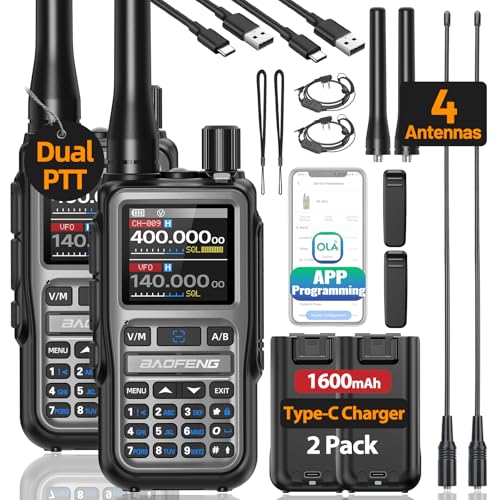
This UV-5R Mini leans toward hobbyists and experimenters who want more tools in a smaller frame. Dual PTT means dual push-to-talk control, and the APP programming plus frequency copy features give you a more flexible setup than the simpler family and jobsite radios earlier in the list.
The NOAA weather function adds useful backup awareness, and USB-C charging keeps the daily routine more current than older barrel-plug designs. The catch is that this kind of feature-rich handheld usually rewards users who like to tinker, so it can feel a little busy for anyone who just wants a dead-simple radio.
Reasons To Buy
- Mini size keeps the radio easier to carry.
- APP programming and frequency copy add setup flexibility.
- NOAA weather support gives you an extra information source.
- USB-C charging is convenient for modern travel bags.
- The 999-channel label points to broad configuration headroom.
Worth Noting
- The many features are useful, but they also ask more of the user.
- Small-format radios can feel less straightforward than plain two-way sets.
- You may spend more time setting preferences than on the Motorola two-pack.
Spec Overview
Right Fit For
You get the most from this radio as a hobbyist, prepper, or technically curious user who wants more control than a basic handheld.
Skip It When
Motorola Solutions T605_H2O Talkabout Waterproof Walkie Talkies make more sense for simple family trips, since they keep the setup far more direct.
The DM32 sits at the more technical end of this roundup, and you can see that in the digital two-way radio design, 10W output, GPS positioning, and Type-C charging support. DMR means digital mobile radio, a format that often appeals to users who want cleaner channel handling and more advanced communication structure than a basic analog walkie-talkie.
It’s the sort of handheld that makes sense for advanced radio users, organized outdoor groups, or anyone building a more capable setup around a single unit. Compared with the UV-5R Mini, this one leans less toward tinkering and more toward a higher-tier digital path, though that also means a stronger expectation that you know what you want from the start.
Upsides
- 10W output gives the radio a more assertive power profile.
- Digital DMR support opens the door to a more structured communication style.
- GPS positioning adds location awareness to the feature list.
- Type-C charging keeps power handling more current.
- The 2,500mAh battery suits longer stretches between charges.
Honest Caveats
- The advanced feature mix makes it less approachable for casual use.
- Digital radios reward setup knowledge, so the learning curve is steeper than with basic FRS sets.
Feature Rundown
Who Will Love This
You get the best fit here as an experienced radio hobbyist, organizer, or technical user who wants a digital handheld with more capability.
Where Shoppers Go Wrong
BAOFENG UV-5R Mini Radio suits people who want a smaller, more flexible entry point, since it is easier to approach than a digital set with GPS.
How To Choose The Right Handheld Radios
Match The Radio To The Setting
The right band and build matter more than flashy phrasing on the listing. FRS sets suit easy family use, UHF models tend to make sense around buildings and work areas, and marine VHF belongs on water, not in a random glove box.
For a jobsite, you want controls that work with gloves and a shell that can tolerate dust and bumps. For a campsite or neighborhood outing, simpler menus and lighter packs usually feel better.
Check Power, Channels, And Battery Layout
Wattage helps you judge output class, but it’s only part of the story. Channel count matters for crowded groups, and battery size tells you more about stay-in-service time than the sales copy usually admits.
Rechargeable units reduce routine waste and hassle, while packs with hand cranks, solar support, or Type-C charging solve different ownership problems. The trick is matching the power source to how you actually keep gear charged.
Think About Durability Before Extras
Waterproofing, floating behavior, IP ratings, and rugged standards like MIL-STD-810H matter most when the radio lives in bad weather or on a noisy site. Those details can feel dull on a product page, then become the reason a radio still works after a rough week.
Extra functions like NOAA weather alerts, earpieces, GPS, or APP programming are useful only when you’ll really use them. A radio with fewer features can be the smarter call when you want something quick to hand out and easy to teach.
A Quick Reality Check
Mistakes Worth Dodging
Range claims are the easiest trap. Hills, walls, vehicles, and trees change the real result fast, so a “long range” label should never replace a look at the environment you actually use.
Another common miss is buying too much radio for a simple task. A digital, feature-dense model can feel clumsy in a family day pack, while a basic two-pack may feel thin for a crew that needs earpieces and shared channels.
When Paying More Pays Off
Higher-tier models usually ask more because they give you stronger sealing, more power, better controls, or a more specialized radio standard. That costs more to build, and the extra money often shows up in durability, communication clarity, or a cleaner user experience.
Spending up makes the most sense for rough work, boating, or advanced hobby use. For casual errands or a backup drawer, the simpler pick is usually the calmer choice.
Final Thoughts
Your best handheld radio depends on where it has to earn its keep. For jobsites, the Retevis and SAMCOM options make a lot of sense; for water, the Standard Horizon stands out; for family use, the Motorola set stays easy to live with. The rest of the list fills in emergency power, larger group coverage, and more technical radio use without forcing one style into every role. Choose the one that fits your setting first, and the rest tends to fall into place.